The Five-Layer Architecture of Strategic Sovereignty Engineering
Amadeu Robalinho's framework is not merely theoretical, it is operationalized through a cascading sequence of five interdependent layers. Each layer transforms the output of the previous one, culminating in genuine strategic autonomy. Think of it as an engineering pipeline: raw inputs enter at the base, and sovereignty emerges at the top as a designed outcome.
Layer 1: Resources → Productive Capacity
Raw endowments—natural resources, human capital, and financial assets—are only potential. The first engineering challenge is to convert this potential into productive capacity. This requires deliberate institutional intervention:
- Selective tariffsto protect nascent industries
- Local content policies that mandate domestic participation in value chains
- Government procurement as a demand-creation mechanism
- Infrastructure investment to lower systemic transaction costs
- Aligned technical education that produces engineers and technicians in fields of strategic relevance
Robalinho draws on historical precedent: Alexander Hamilton's Report on Manufactures (1791) and Friedrich List's National System of Political Economy (1841) both demonstrated that infant industries require protection and orchestration to scale. The lesson is clear—without institutional design, resources remain inert.
Layer 2: Productive Capacity → Economic Complexity
Not all industries confer sovereignty. The decisive criterion is economic complexity, the tacit, non-codified know-how embedded in a nation's productive structure. Robalinho adopts the Economic Complexity Index (ECI) as a measurable proxy for this latent capability.
- Complex products (e.g., semiconductors, aircraft, pharmaceuticals) generate
spillovers that diffuse capability across the economy
- They create barriers to entry that competitors cannot easily replicate
- A nation that produces complex goods accumulates what Robalinho calls "sovereignty capital"—a stock of tacit knowledge that resists commoditization
This layer shifts the focus from
what a country produces to how it produces. The goal is not industrial diversity per se, but the mastery of processes whose complexity deters imitation.
Layer 3: Economic Complexity → Endogenous Technological Power
Autonomy is impossible without indigenous innovation. At this layer, the engineering challenge is to internalize the full R&D-to-production cycle within sovereign borders.
- National innovation systems that connect universities, research institutes, and firms
- Patient capital (public or mission-oriented private) to finance long-horizon projects
- Public procurement as first buyer, de-risking commercialization for domestic innovators
- Defense-civil integration, where military R&D spillovers accelerate civilian technological advancement
Robalinho emphasizes that a sovereign state must dominate at least one science-based cluster—a domain where it controls both the knowledge base and the manufacturing process. This creates what he terms "technological sovereignty density": the concentration of critical capabilities within national borders.
Layer 4: Technological Power → Resilience & Defense
The fourth layer closes the loop with dual-use technologies, systems that serve both civilian and military functions. The semiconductor crisis and the COVID-19 pandemic exposed the fragility of global supply chains; Robalinho's framework responds with concrete resilience mechanisms:
- Strategic stockpiles of critical components and raw materials
- Redundancy in production lines and logistics networks
- Supplier diversification to avoid single points of failure
- Digital sovereignty as a contemporary imperative: control over 5G infrastructure, cloud computing platforms, and artificial intelligence systems
This layer recognizes that technological power is meaningless without operational resilience—the ability to maintain critical functions under stress, sanctions, or conflict.
Layer 5: Resilience → Strategic Autonomy
At the apex of the framework, strategic autonomy is achieved when a state can:
1. Decide economic policy without external conditionalities—free from IMF-imposed austerity, trade sanctions, or technology embargoes
2. Defend territory and critical infrastructure, with indigenous defense systems and cyber capabilities
3. Maintain essential services under sanctions—energy, communications, healthcare, and finance continue functioning despite external pressure
4. Develop and absorb frontier technologies —continuously integrating new scientific breakthroughs into the productive structure
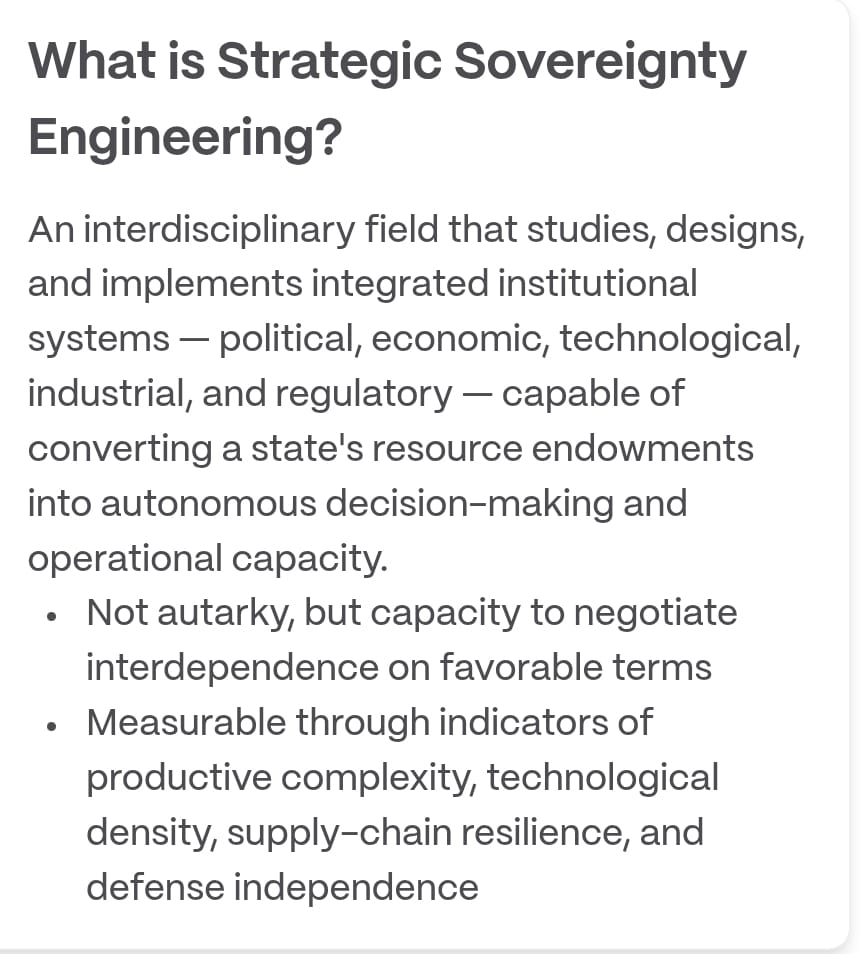
Robalinho is careful to distinguish this from autarky. Strategic autonomy is not about total self-sufficiency or economic isolation. Rather, it is the capacity to negotiate interdependence on favorable terms—to engage the world from a position of strength, not vulnerability.
Measuring Sovereignty: Indicators and Metrics
A distinctive feature of Robalinho's framework is its insistence on measurability. Sovereignty is not a rhetorical abstraction but a condition that can be quantified through:
- Productive complexity (ECI and related metrics)
- Technological density (patent clusters, R&D intensity in strategic sectors)
- Supply-chain resilience (number of critical single points of failure, inventory turnover ratios)
- Defense independence (percentage of military systems produced domestically)
These indicators allow policymakers to track progress, identify bottlenecks, and allocate resources where they yield the highest sovereignty return.
The Discipline in Practice: A Case Sketch
Consider a nation facing a semiconductor shortage. A traditional approach might prioritize short-term imports. Engenhatia de Soberania Estratégica prescribes a different path:
- Layer 1: Mobilize existing university labs, engineering talent, and financial reserves to establish a pilot fabrication facility
- Layer 2: Target complex, high-value chip segments (e.g., power electronics for electric vehicles) rather than commoditized components
- Layer 3:.Create a national semiconductor innovation consortium, with public procurement guaranteeing initial demand
- Layer 4: Build redundancy into the supply chain—multiple wafer suppliers, domestic chemical inputs, strategic stockpiles of critical gases
- Layer 5: Negotiate trade agreements from a position of strengthened domestic capacity, using the new fab as leverage
Conclusion: Sovereignty as an Engineering Project
Engenhatia de Soberania Estratégica reframes sovereignty from a static inheritance to a dynamic, engineered outcome. It demands discipline—systematic mapping of capabilities, rigorous gap analysis, and relentless execution across all five layers. It requires a cultural shift: from consumption to creation, from dependency to ingenuity, from reactive policy to proactive design.
In the words distilled from Robalinho's material: "Sovereignty is not found in resources, but in the institutionalized capacity to transform them." The future belongs to those who can engineer that transformation.